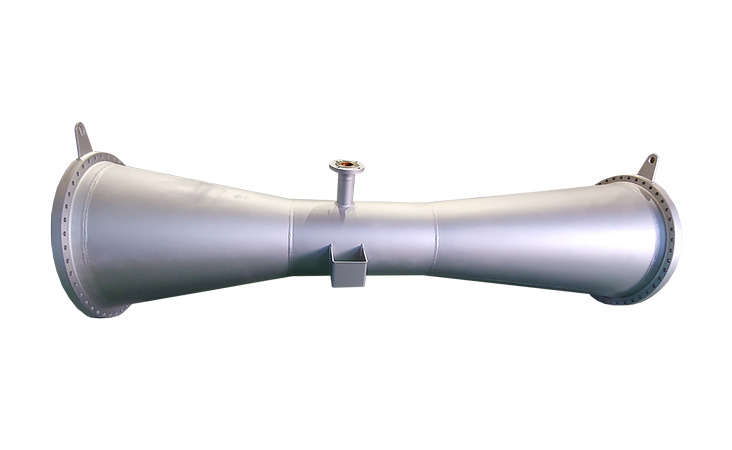
DESUPERHEATER

About the
DESUPERHEATER
Process steam used in typical plants is supplied from boilers in a superheated state (above saturation temperature). The difference between the actual steam temperature and the saturation temperature is called "superheat." As steam travels from the boiler to process equipment, efficiency can decrease due to condensation or heat loss through piping. To prevent this, maintaining an appropriate degree of superheat is essential. However, excessive superheat actually reduces heat energy transfer efficiency, so desuperheaters are used upstream of steam-consuming processes to adjust the steam temperature closer to saturation temperature. Desuperheaters are critical devices that enhance the energy efficiency of steam delivered to heat exchangers, process equipment, or turbines while also protecting equipment.
Advantage
Improved heat exchange efficiency through steam supply near the saturation state
Equipment protection for turbines, heat exchangers, and other devices
Maintained process quality through reduced condensate and controlled steam quality
How it works

All desuperheaters operate on the same fundamental principle. Condensate or process water is injected into the high-temperature, superheated steam line, where direct contact with the steam causes the water to evaporate and lower the steam temperature. The injected water absorbs heat from the steam as it evaporates, reducing the steam temperature, and the outlet steam temperature is precisely controlled by the amount of water evaporated. It is advisable to use injection water at a temperature as close as possible to the steam temperature. This effectively absorbs the latent heat needed to reduce steam temperature, ensuring complete evaporation of water within the steam and preventing water droplets from forming on the pipe walls. As a result, desuperheaters maintain steam quality, maximize heat transfer efficiency, and help protect process equipment.
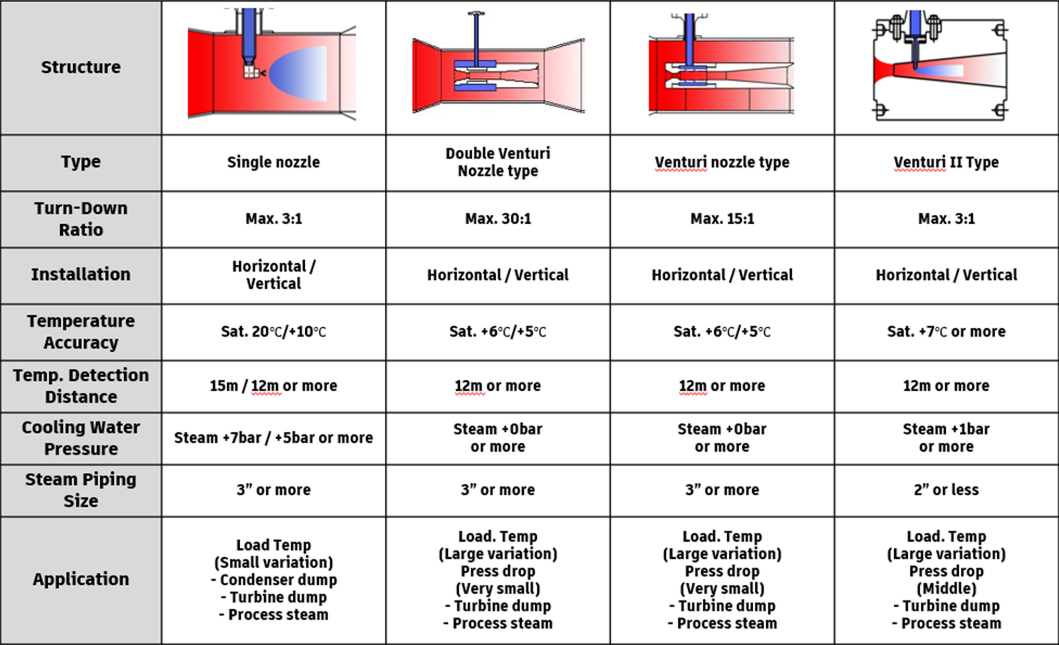
Types of DESUPERHEATER
Spray Nozzle Type
Operates by injecting water into the steam through nozzles, atomizing it into a fine mist to reduce temperature through heat exchange with the steam.
Control performance is determined by nozzle design, with precise nozzle engineering leading directly to high control accuracy.
Simple structure results in virtually no pressure loss throughout the system.
Thanks to this simple configuration and high cost-effectiveness, the spray nozzle type is recognized as one of the most common and economical desuperheaters on the market.
Venturi Nozzle Type
An ideal solution when high-pressure injection water is not available
The required injection water pressure needs only to be approximately 1 kg/cm² higher than the steam pressure.
In some cases, it can operate with water pressure at the same level as steam pressure.
Injection water flows directly into the venturi nozzle, where it is naturally atomized into fine particles inside the nozzle.
Pressure loss throughout the system is very minimal.
Use Cases
Power Plants
Conducting turbine blade protection and steam quality maintenance by controlling superheated steam to the saturation state
Refining/Petrochemical
Maintaining steam temperature suited to reaction conditions, catalyst protection, and process stabilization
Chemical Industry
Supplying saturated steam instead of superheated steam to temperature-sensitive reactors
Plant Processes
Supplying steam at a consistent temperature required throughout process operations
Food/Dairy
Ensuring food quality uniformity and safety with steam at a constant temperature
Paper Industry
Improving drying quality through temperature control of steam for paper drying
Technial Data